
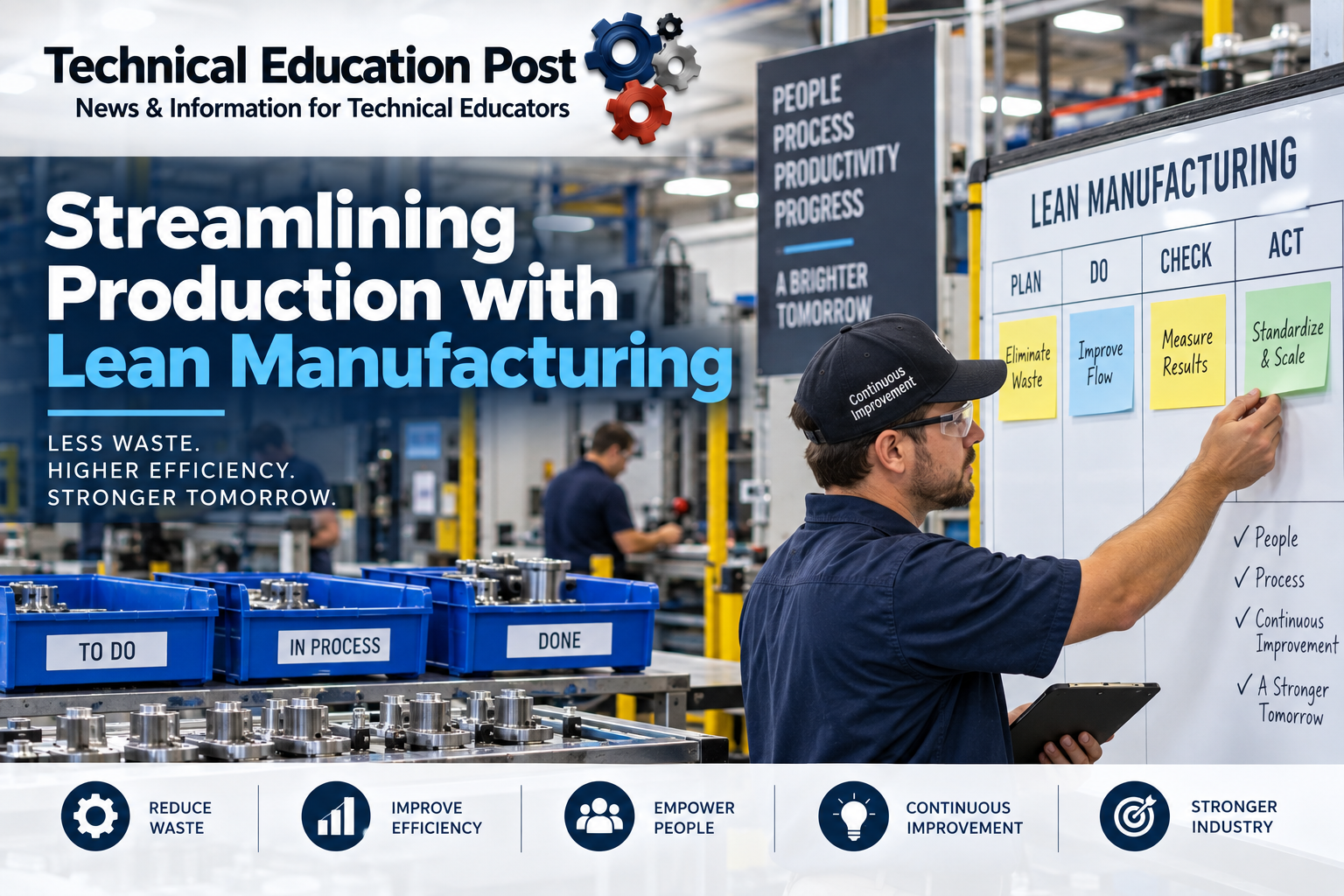

The Agile Factory: Streamlining Production with Lean Manufacturing
In today’s competitive manufacturing landscape, efficiency isn’t just a buzzword; it’s a critical driver of success. Companies are constantly seeking ways to optimize their operations, reduce costs, and deliver higher quality products faster. One of the most powerful and enduring methodologies to achieve these goals is Lean Manufacturing. Developed in Japan, particularly by Toyota, Lean is a systematic approach to identifying and eliminating waste in all its forms, thereby maximizing customer value. Whether you’re a student exploring manufacturing careers, an educator shaping the next generation, a technician on the shop floor, or a seasoned manufacturing professional, understanding Lean principles is essential for thriving in the modern industrial environment.
Lean Manufacturing is a methodology that focuses on minimizing waste while maximizing productivity, and it has been widely adopted across various industries, including automotive. For those interested in exploring how Lean principles are applied in the automotive sector, a related article can be found at Tech Ed Magazine, which discusses the importance of automotive technology programs in Dallas and their role in fostering efficient manufacturing practices.
Understanding the Core Philosophy of Lean Manufacturing

At its heart, Lean Manufacturing is about creating more value for the customer with fewer resources. It’s a philosophy that permeates every level of an organization, from top management to frontline workers, fostering a culture of continuous improvement. The ultimate aim is to build a smooth, efficient flow of production, where materials and information move seamlessly without interruption or delay.
What Exactly is “Waste” in Lean?
The concept of “waste” (or “muda” in Japanese) is central to Lean. It’s defined as anything that consumes resources but does not add value from the customer’s perspective. Lean identifies seven primary types of waste, often remembered by the acronym TIMWOOD or DOWNTIME:
- Transportation: Unnecessary movement of materials or products. This can be between workstations, warehouses, or even within the same area.
- Inventory: Holding more raw materials, work-in-progress (WIP), or finished goods than immediately needed. Excess inventory hides problems, ties up capital, and increases handling costs.
- Motion: Unnecessary movement of people or equipment. This includes reaching, bending, walking, or searching for tools and materials.
- Waiting: Idle time for people or machines due to bottlenecks, equipment breakdowns, or lack of materials.
- Overproduction: Producing more than is needed, or producing it sooner than needed. This is often considered the worst form of waste because it leads to other types of waste, like excess inventory.
- Overprocessing: Doing more work on a product than the customer requires or is willing to pay for. This could involve unnecessary inspections, overly tight tolerances, or redundant steps.
- Defects: Producing faulty products that require rework, scrap, or customer complaints. Defects directly impact quality and cost.
Some interpretations of Lean also include an eighth waste: Underutilized Talent (or skills). This refers to not fully leveraging the knowledge, creativity, and problem-solving abilities of employees.
The Customer is King: Defining Value in Lean
In Lean, “value” is defined exclusively by the customer. It’s what the customer is willing to pay for. Anything else is considered non-value-adding. For example, a customer buying a car doesn’t pay for the time the car spends sitting in inventory between manufacturing stages. They pay for the finished, functional vehicle. Lean seeks to aggressively remove all activities that don’t directly contribute to creating that valuable end product.
How Lean Manufacturing Achieves Efficiency: Key Principles and Tools

Lean isn’t just a philosophy; it’s a practical methodology backed by a toolkit of proven principles and techniques. These tools are designed to help organizations systematically identify and eliminate waste, improve flow, and achieve a state of continuous improvement.
The Pillars of Lean: Flow and Pull
Two fundamental concepts underpin Lean Manufacturing:
- Flow: The idea of creating an uninterrupted, smooth progression of products or services through the value stream. This means eliminating bottlenecks, reducing batch sizes, and ensuring that work moves continuously from one stage to the next without stopping or waiting. A good analogy is a river flowing smoothly, rather than a series of stagnant pools.
- Pull: In contrast to traditional “push” systems (where production is based on forecasts and pushed to the next stage), Lean employs “pull” systems. Here, downstream processes signal to upstream processes when they need more materials or components. Production is “pulled” through the system based on actual customer demand. This prevents overproduction and reduces inventory.
Essential Lean Tools and Techniques
A wide array of tools and techniques are employed in Lean Manufacturing. Here are some of the most prominent:
Just-In-Time (JIT) Production
JIT is a cornerstone of Lean. It aims to have the right parts, in the right quantities, at the right time, and in the right place. This minimizes inventory holding costs, reduces lead times, and makes the production system more responsive to changes in demand. For JIT to be successful, a high degree of reliability in suppliers and internal processes is crucial.
Kanban Systems
Kanban, meaning “signboard” or “visual signal” in Japanese, is a signaling system used to manage JIT production. It utilizes cards, bins, or other visual cues to indicate when more materials are needed. When a container is emptied, its Kanban card is sent back to the preceding production station, triggering the production or delivery of another container. This visual control ensures that production is only initiated when there is a demand for it.
Value Stream Mapping (VSM)
VSM is a powerful analytical tool used to visualize the entire flow of materials and information required to bring a product or service from its inception to the customer. It maps out every step in the process, identifying both value-adding and non-value-adding activities (waste). By mapping the “current state,” organizations can then design an improved “future state” to eliminate waste and improve flow. VSM provides a high-level overview, making it an excellent starting point for Lean initiatives.
Kaizen (Continuous Improvement)
Kaizen is a philosophy of continuous, incremental improvement involving all employees, from top management to frontline workers. It’s about constantly looking for small ways to improve processes, reduce waste, and enhance quality. Kaizen events, often short, focused workshops, bring teams together to brainstorm and implement immediate improvements in specific areas. The spirit of Kaizen is that perfection is an ongoing journey, not a destination.
Lean Manufacturing focuses on maximizing value while minimizing waste, and it has been widely adopted across various industries to improve efficiency and productivity. A related article discusses innovative approaches in engineering that align with these principles, showcasing how technology can enhance manufacturing processes. You can read more about this topic in the article on engineering advancements by visiting this link.
5S Methodology
The 5S methodology is a workplace organization and standardization system designed to create a clean, organized, and efficient work environment. The five steps, all starting with ‘S’ in Japanese, translate to:
- Seiri (Sort): Separate necessary items from unnecessary ones and remove the unnecessary.
- Seiton (Set in Order): Arrange necessary items so they are easy to find, use, and return. “A place for everything, and everything in its place.”
- Seiso (Shine): Clean the workplace thoroughly. This also serves as an inspection, identifying potential problems.
- Seiketsu (Standardize): Establish standards for the first three S’s to maintain order and cleanliness.
5.