
The College of Southern Maryland is building something more significant than a new set of manufacturing courses.
It is developing the infrastructure to connect hands-on advanced manufacturing training, an industry credential, employers and Registered Apprenticeship within a more integrated regional workforce pipeline.
The College of Southern Maryland (CSM) announced September 10 that its Velocity Center will receive new manufacturing training equipment and launch three courses supported by a $52,000 TEDCO Makerspace Initiative grant. Students completing the courses will be prepared to pursue the Certified Manufacturing Associate (CMfgA) credential while developing skills relevant to defense, aerospace, precision manufacturing and fabrication.
At the same time, CSM is partnering with JobForward through a nearly $1 million grant to develop an advanced manufacturing Registered Apprenticeship Program. CSM plans to serve as a program sponsor, helping employers navigate administration, compliance and training coordination.
Together, those initiatives create the possibility of a more continuous pathway:
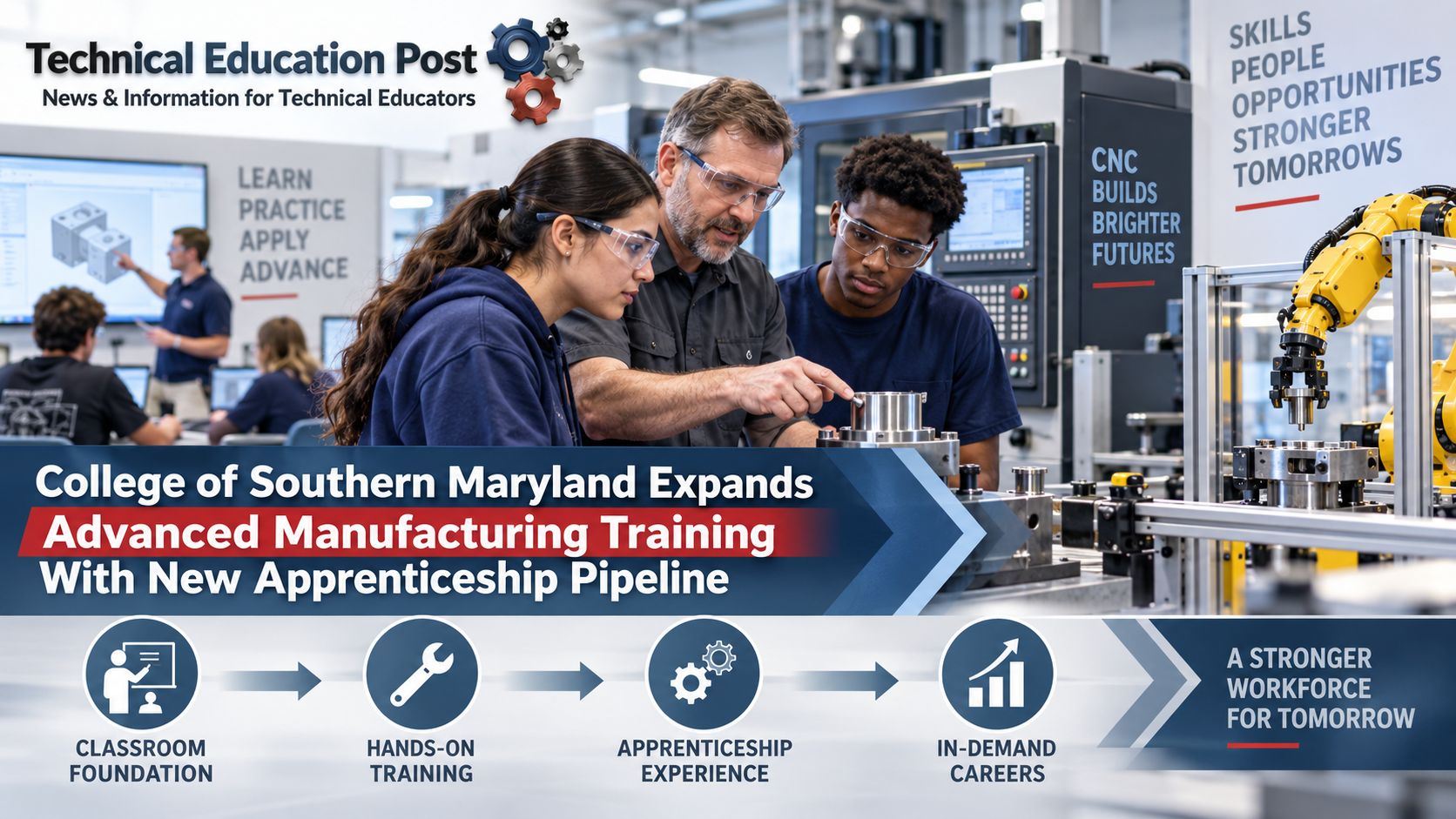
Makerspace training → technical skills → industry credential → employer participation → Registered Apprenticeship → advanced manufacturing career
For community colleges looking for ways to connect education more directly with employment, that model deserves attention.
Key Takeaways
- CSM received $52,000 through TEDCO’s Makerspace Initiative Program for instructional equipment and three new manufacturing courses at its Velocity Center.
- Students completing the courses will be prepared to pursue the Certified Manufacturing Associate (CMfgA) credential.
- Training is being designed around workforce needs in defense, aerospace, precision manufacturing and fabrication.
- CSM is also partnering with JobForward through a nearly $1 million grant to develop an advanced manufacturing Registered Apprenticeship Program.
- CSM intends to become a Registered Apprenticeship Program sponsor, providing administrative, compliance and training support for participating employers.
- JobForward’s funding is part of Maryland’s broader $5 million Industry Apprenticeship Accelerator.
- Across Maryland, the initiative is expected to help establish 14 new Registered Apprenticeship Programs, recruit nearly 150 employers and add more than 650 apprentices.
- The larger lesson for technical education is that community colleges can do more than deliver training: they can become the intermediary infrastructure connecting learners, employers, credentials and apprenticeship.
What CSM Is Building at the Velocity Center
The College of Southern Maryland’s Velocity Center is already designed as a bridge between education, industry, government and the surrounding community.
The 13,000-square-foot facility in Indian Head, Maryland, sits outside the Naval Surface Warfare Center, Indian Head Division. CSM describes it as a collaborative space for academia, the Navy and the community focused on innovation, workforce development and regional economic growth.
Its Makerspace occupies approximately 1,984 square feet and provides a collaborative environment for hands-on learning, making and experimentation.
The new TEDCO funding will expand the workforce role of that space.
According to CSM, the $52,000 grant will support new instructional equipment and three new courses providing hands-on manufacturing training.
The courses are intended to prepare students for the Certified Manufacturing Associate credential and build foundational skills applicable to several strategically important industries.
That makes the investment more than an equipment upgrade.
The college is connecting physical training capacity with a recognizable credential and an employment pathway.
The Credential Is a Step, Not the Destination
Industry credentials have become an increasingly prominent part of CTE and workforce development.
But the value of a credential depends heavily on what happens after someone earns it.
A certificate with little employer recognition or no connection to available jobs has limited value.
CSM’s approach is potentially stronger because the credential is being positioned inside a larger workforce system.
Students develop skills.
They prepare for an industry credential.
Employers participate in the apprenticeship ecosystem.
Apprentices receive structured paid training.
And the college can remain involved as both an education provider and apprenticeship sponsor.
That closely reflects a principle Technical Education Post has emphasized in its coverage of CTE and Workforce Development: education and workforce systems produce stronger pathways when training is tied directly to credentials, employers and real labor-market opportunities.
The Apprenticeship Piece Changes the Model
The more consequential development may be CSM’s partnership with JobForward.
Through a nearly $1 million grant, JobForward will support the college in developing and implementing an advanced manufacturing Registered Apprenticeship Program.
CSM plans to operate as the program sponsor.
That matters because Registered Apprenticeship requires considerably more infrastructure than simply placing a student with an employer.
Standards must be established.
Programs must satisfy state requirements.
Training must be coordinated.
Employers need assistance.
Records and compliance requirements must be managed.
Someone has to connect the pieces.
CSM says the funding will support the development of apprenticeship standards, state approvals and the infrastructure necessary for the college to serve as a Registered Apprenticeship Program sponsor.
That potentially changes the role of the community college from training provider to workforce intermediary.
Why the Intermediary Role Matters
Registered Apprenticeship can be particularly challenging for smaller employers.
A large corporation may have dedicated human-resources, training and compliance departments capable of building and operating apprenticeship programs.
A smaller precision manufacturer may not.
The company might desperately need machinists, maintenance technicians or manufacturing specialists while lacking the staff necessary to create an apprenticeship program from scratch.
Maryland’s Industry Apprenticeship Accelerator is specifically designed to address that problem through intermediaries.
The Maryland Department of Labor describes intermediaries as organizations that help employers and labor organizations build and expand Registered Apprenticeship programs by connecting sponsors, employers and participants, convening partners and providing the functions necessary to scale programs.
Community colleges are well positioned to play that role.
They already have instructors.
They have laboratories.
They understand curriculum.
They interact with employers.
They serve both traditional students and adult learners.
And they frequently operate workforce-development divisions capable of responding more quickly than traditional academic programs.
CSM’s own WorkForce Center, for example, provides customized workforce programming designed around employer needs.
Adding apprenticeship sponsorship can make the college an even more important piece of regional workforce infrastructure.
Maryland Is Trying to Scale the Model
CSM’s project is part of a much larger statewide apprenticeship strategy.
Maryland allocated $5 million to the Industry Apprenticeship Accelerator for fiscal year 2026. The initiative was established following passage of the state’s Registered Apprenticeship Investments for a Stronger Economy, or RAISE Act.
The program focuses in part on industries where apprenticeship has historically been uncommon or underused.
In June, Maryland announced nine intermediary grantees. JobForward was selected for engineering, manufacturing and logistics on a statewide basis.
Collectively, Maryland expects the funded projects to:
Develop 14 new Registered Apprenticeship Programs
Recruit nearly 150 employers
Add more than 650 apprentices
The nine funded intermediaries span sectors including manufacturing, engineering, logistics, information technology, cybersecurity, healthcare, agriculture, financial services and early childhood education.
The initiative also brings more than state funding to the table.
Maryland says participating organizations will leverage more than $5 million in additional financial and in-kind contributions from employers, educational institutions, workforce organizations, philanthropies and other partners.
The strategy is therefore not simply to fund individual apprenticeship slots.
It is to build organizations capable of making apprenticeship easier to create and scale.
Manufacturing Is Well Suited to This Approach
Advanced manufacturing presents a particularly strong case for an integrated education-to-apprenticeship pathway.
Employers increasingly need workers with combinations of mechanical, electrical, digital and problem-solving skills.
Many occupations are difficult to prepare for entirely inside a classroom.
Students need theoretical instruction, but they also need to work with equipment, understand production environments and develop the judgment that comes from applying skills under real operating conditions.
Apprenticeship combines those two forms of learning.
That makes it a natural complement to community-college manufacturing programs.
Technical Education Post’s America’s Advanced Manufacturing Workforce has examined how automation and advanced technologies are increasing the technical demands placed on the manufacturing workforce.
The challenge is no longer simply producing more workers.
It is creating reliable systems capable of developing workers with the right combination of technical knowledge and applied experience.
A Potential Pipeline From Makerspace to Manufacturing Career
The most compelling aspect of CSM’s initiative is what happens when its individual components are viewed together.
1. Hands-On Exposure
Students begin in the Velocity Center Makerspace and manufacturing courses.
They encounter equipment, processes and applied technical problems rather than relying exclusively on classroom instruction.
2. Structured Technical Training
The three new courses create a more formal learning sequence focused on manufacturing careers.
3. Industry Credential
Students completing the training will be prepared to pursue the Certified Manufacturing Associate credential.
4. Employer Connection
The apprenticeship initiative brings employers directly into the talent-development system.
5. Registered Apprenticeship
Participants can potentially transition into structured earn-and-learn programs that combine employment with related instruction.
6. Long-Term Employment
The objective is ultimately not course completion or credential attainment.
It is successful entry and advancement in manufacturing careers.
That distinction matters.
Technical education should increasingly be judged by whether learners can move through the entire pathway—not merely whether institutions can enroll them in its first step.
Community Colleges Can Become Workforce Hubs
For decades, community colleges have occupied an unusual position in American education.
They operate between high schools, universities, employers and adult workforce systems.
That position can sometimes make their mission complicated.
It can also make them uniquely valuable.
A community college can simultaneously provide:
- academic education;
- technical training;
- industry credentials;
- customized employer training;
- career services;
- work-based learning;
- apprenticeship-related instruction; and
- regional workforce coordination.
CSM’s model pushes that role one step further by taking responsibility for apprenticeship infrastructure.
That can be particularly valuable in regions dominated by small and midsize employers.
Instead of requiring every company to independently understand the apprenticeship system, the college can help provide a common platform.
The Model Also Reduces Employer Friction
This may be one of the most important aspects of Maryland’s strategy.
Employers frequently say they need skilled workers.
That does not necessarily mean they have the time or expertise to operate workforce-development programs.
Maryland’s apprenticeship accelerator explicitly seeks to reduce those administrative barriers by funding intermediaries that can guide employers through program development and expansion.
CSM can potentially provide that function locally.
An employer can focus on providing employment, mentorship and on-the-job learning while the college helps manage the surrounding apprenticeship structure.
If executed well, that division of responsibilities could make apprenticeship practical for employers that otherwise would never launch a program.
This Fits a Larger Shift in Apprenticeship Policy
The CSM project also arrives as apprenticeship is becoming more central to state and federal workforce strategies.
Maryland’s program is intentionally targeting sectors where Registered Apprenticeship is uncommon or underutilized, rather than limiting the model to occupations that have historically relied on apprenticeship.
That is an important policy shift.
Apprenticeship has long been associated most visibly with construction and the skilled trades.
Those remain essential apprenticeship sectors.
But states are increasingly applying the earn-and-learn model to advanced manufacturing, healthcare, IT, cybersecurity, logistics and other occupations.
Technical Education Post has repeatedly covered the importance of connecting CTE and workforce-development systems rather than treating education, credentials and employment as separate initiatives.
CSM provides a practical example of what that integration can look like at the community-college level.
What Other Community Colleges Can Learn From CSM
The model is worth examining even for colleges without access to the same grants.
The first lesson is to design backward from employment.
Instead of asking only what courses the institution can offer, start by identifying the occupations employers need to fill.
Then determine the competencies those occupations require.
Identify credentials employers actually value.
Build the appropriate hands-on training.
And create a mechanism for transitioning students into work.
The second lesson is that employer participation should be structural rather than occasional.
An advisory-board meeting twice a year is not the same as employers participating directly in an apprenticeship system.
The third is that someone must own the infrastructure.
Workforce partnerships often fail because everyone supports the concept but no organization is responsible for administration, coordination and accountability.
CSM’s decision to develop the capacity to serve as a Registered Apprenticeship sponsor addresses that problem directly.
Questions to Ask Your Program
Does our manufacturing training lead somewhere specific?
Students should be able to see the pathway from enrollment to credential to employment.
Do employers recognize the credentials we offer?
Credential value should be validated through actual employer demand.
Could our institution sponsor Registered Apprenticeship?
Colleges should examine whether they have the capacity—or could develop partnerships—to handle apprenticeship administration.
Are smaller employers being excluded by administrative complexity?
If so, an intermediary model may help.
Does our lab equipment reflect current industry practice?
Hands-on training loses value when students learn exclusively on obsolete systems.
Are employers involved in curriculum and training design?
Their participation should extend beyond occasional advisory meetings.
Can students earn while they learn?
Apprenticeship can make technical education more accessible to learners who cannot stop working to attend school full time.
What happens after a student earns a credential?
Placement, apprenticeship participation, retention, wages and advancement are stronger measures of workforce value than credential counts alone.
What to Watch Next
The most important milestone will be the development and approval of CSM’s advanced manufacturing Registered Apprenticeship Program.
The college and JobForward still have implementation work ahead.
Funding will support development of apprenticeship standards, state approvals and the administrative infrastructure necessary for CSM to become a program sponsor.
That means the program should be evaluated on outcomes rather than announcements.
Important measures will include:
- the number of employers participating;
- the occupations included;
- apprentice enrollment;
- completion rates;
- credential attainment;
- employer retention;
- wage progression; and
- whether smaller manufacturers actually find apprenticeship easier to adopt.
Maryland’s statewide targets provide another important benchmark.
If the Industry Apprenticeship Accelerator successfully produces 14 programs, nearly 150 participating employers and more than 650 apprentices, it could provide evidence for other states considering intermediary-based apprenticeship expansion.
Frequently Asked Questions
What is the College of Southern Maryland manufacturing initiative?
CSM is adding manufacturing equipment and three new courses at its Velocity Center while simultaneously developing an advanced manufacturing Registered Apprenticeship Program with JobForward.
How much funding did the Velocity Center receive?
CSM received a $52,000 TEDCO Makerspace Initiative grant for instructional equipment and manufacturing courses. It is also partnering with JobForward through a nearly $1 million grant supporting Registered Apprenticeship development.
What credential will students be prepared to earn?
Students completing the new manufacturing courses will be prepared to pursue the Certified Manufacturing Associate (CMfgA) credential.
Which industries are being targeted?
CSM identifies defense, aerospace, precision manufacturing and fabrication among the industries the new training is intended to support.
What role will CSM have in Registered Apprenticeship?
CSM is developing the infrastructure to serve as a Registered Apprenticeship Program sponsor, helping employers with administration, compliance and training coordination.
What is Maryland’s Industry Apprenticeship Accelerator?
It is a state grant initiative created to expand Registered Apprenticeship through intermediary organizations that help employers and partners develop, launch and scale programs, particularly in sectors where apprenticeship is underused.
How large is Maryland’s apprenticeship investment?
Maryland awarded $5 million through the Industry Apprenticeship Accelerator to nine intermediaries. The funded projects are expected to establish 14 new programs, recruit nearly 150 employers and add more than 650 apprentices.
Why use a community college as an apprenticeship sponsor?
Community colleges already possess training facilities, instructors, employer relationships and workforce-development capabilities. Sponsorship can allow them to manage some of the administrative infrastructure that otherwise makes apprenticeship difficult for individual employers to establish.
Technical Education Post Perspective
The most important part of the College of Southern Maryland story is not the $52,000 equipment grant.
It is the architecture surrounding it.
A makerspace by itself is useful.
A manufacturing course can be valuable.
An industry credential can help.
An apprenticeship can create an employment pathway.
But the real opportunity comes from connecting all four.
Too many workforce initiatives operate as isolated programs. Students complete training and then have to figure out what comes next. Employers report worker shortages while remaining disconnected from education programs. Colleges count credentials without knowing whether those credentials lead to meaningful employment.
CSM and JobForward are attempting to build the connective tissue between those pieces.
The result could turn a community college into something broader than a place where students receive instruction.
It becomes a regional workforce hub—a place where education, employers, credentials, apprenticeship and employment converge.
For advanced manufacturing, that may be exactly the kind of infrastructure the workforce pipeline needs.
Recommended Reading
CTE and Workforce Development — Why education and workforce-development systems produce stronger pathways when they work together.
America’s Advanced Manufacturing Workforce — How automation and emerging technologies are changing manufacturing occupations and technician skill requirements.
Students Share Benefits of CTE — Examples of credentials, work-based learning and manufacturing pathways connecting students with postsecondary education and employment.
Sources
College of Southern Maryland — Velocity Center Receives Grants to Launch Manufacturing Workforce Training — Primary source for the TEDCO funding, new manufacturing courses, CMfgA preparation, JobForward partnership and CSM’s planned Registered Apprenticeship sponsorship.
Maryland Department of Labor — Industry Apprenticeship Accelerator — Official program information explaining Maryland’s intermediary model and funded industry sectors.
Maryland Department of Labor — $5 Million Apprenticeship Accelerator Awards — Primary state source for the nine intermediary awards and statewide targets of 14 programs, nearly 150 employers and more than 650 apprentices.
Maryland Department of Labor — Industry Apprenticeship Accelerator Program Policy — Official policy document describing the program’s statutory basis, objectives, eligible intermediaries and target sectors.
College of Southern Maryland — Velocity Center at Indian Head — Official information about the facility, Makerspace and workforce-development mission.