
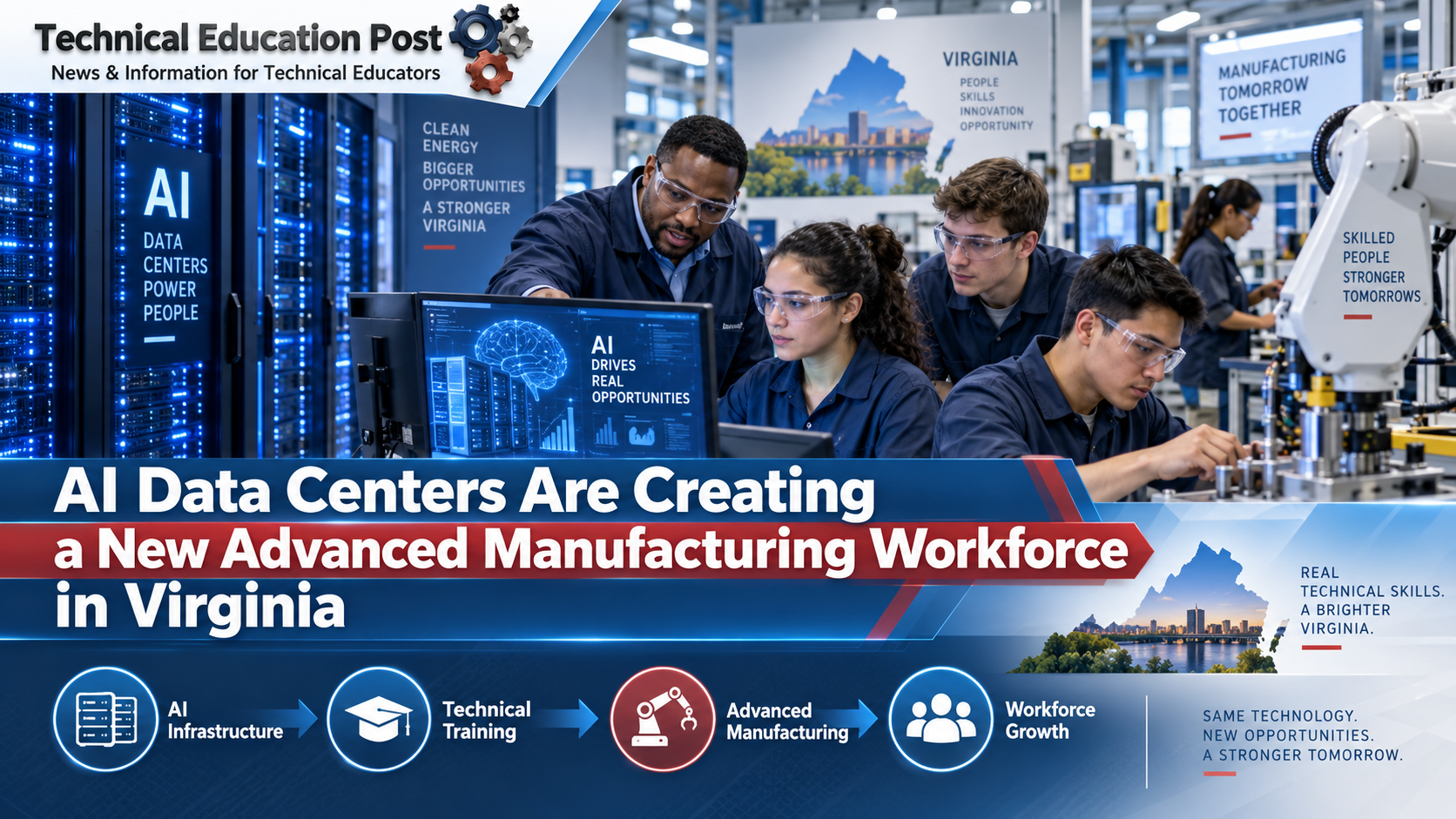

The artificial intelligence workforce is much larger than software engineers, data scientists and machine-learning specialists.
Behind every AI model is an expanding physical infrastructure of data centers filled with servers that require enormous amounts of electricity, sophisticated cooling systems and technicians capable of keeping mission-critical equipment operating around the clock.
A major manufacturing expansion in Virginia provides a particularly clear example of this less-visible AI workforce.
Munters has completed an expansion of its data-center cooling manufacturing campus in Daleville, Virginia, bringing the operation to approximately 565,000 square feet and nearly 600 employees. The nearly $30 million project added roughly 200,000 square feet of manufacturing, testing and training capacity and is expected to create approximately 270 additional jobs.
The campus manufactures equipment essential to modern data centers, including chillers, computer-room air handlers, fan-coil arrays and coolant distribution units. It also contains new production test stands, a chiller laboratory with an advanced environmental chamber and the Munters Service Academy, where technical personnel can be trained to support increasingly sophisticated cooling systems.
Munters directly attributes the need for additional capacity to the rapid growth of artificial intelligence and high-performance computing.
For technical educators, that connection deserves attention.
The AI economy isn’t simply creating demand for people who build algorithms. It is creating another workforce responsible for building, installing, testing, commissioning, operating and maintaining the physical systems that make AI computing possible.
Key Takeaways
- Munters has expanded its Daleville, Virginia, data-center cooling campus to approximately 565,000 square feet with nearly 600 employees.
- The nearly $30 million expansion adds approximately 200,000 square feet and is expected to create about 270 additional jobs.
- Munters manufactures air-side economizers, SyCool Split systems, computer-room air handling units, fan-coil arrays, coolant distribution units and chillers at the campus.
- Chiller manufacturing previously performed in Italy has now been brought to the Virginia operation.
- The expanded facility includes production testing, a chiller laboratory and the Munters Service Academy.
- Munters says growth in AI and high-performance computing is creating new demands for energy, water and physical data-center infrastructure.
- The U.S. Department of Energy says continued American AI leadership requires not only computing and energy infrastructure but also an expanded skilled workforce.
- The emerging AI-infrastructure workforce creates opportunities for CTE programs and community colleges in HVAC, electrical systems, controls, industrial maintenance, advanced manufacturing and mission-critical facility operations.
The Physical Infrastructure Behind Artificial Intelligence
Artificial intelligence can appear almost entirely digital from the user’s perspective.
Someone opens a browser, enters a prompt and receives an answer.
But the process behind that interaction is intensely physical.
AI workloads run on servers.
Servers consume electricity.
Electricity becomes heat.
That heat has to be removed continuously and reliably.
As AI models become more computationally demanding and data centers deploy increasingly dense computing hardware, thermal management becomes a significant engineering challenge.
Munters said earlier this year that the expansion of AI and high-performance computing is transforming data-center cooling requirements, particularly as facilities move toward higher-density computing environments.
That means the AI infrastructure boom is simultaneously becoming a cooling-infrastructure boom.
And cooling infrastructure has to be engineered and manufactured somewhere.
Virginia Is Now Manufacturing More of That Infrastructure
Munters’ Daleville campus is the company’s largest of five dedicated manufacturing facilities in its Data Center Technologies business.
The expanded operation manufactures the company’s broad portfolio of data-center cooling products, including:
- air-side economizers;
- SyCool Split systems;
- computer-room air handling units;
- fan-coil arrays;
- coolant distribution units; and
- chillers.
The expansion also enabled Munters to begin manufacturing chillers in Virginia that were previously produced in Italy.
That detail is particularly important from a workforce-development perspective.
AI infrastructure demand isn’t merely creating construction around data centers.
It can also create domestic advanced-manufacturing activity throughout the data-center supply chain.
The people producing cooling systems aren’t necessarily working inside a data center.
They may be working in manufacturing plants hundreds of miles away, fabricating components, assembling equipment, wiring controls, performing quality assurance and testing completed systems before they are shipped to a customer.
This expands the definition of the AI workforce considerably.
AI’s Workforce Is Larger Than the Technology Sector
The Department of Energy now explicitly connects AI expansion with workforce development.
DOE’s current data-center resource strategy states that maintaining U.S. leadership in AI will require additional energy infrastructure, computing capacity and an expanded skilled workforce.
That workforce extends across multiple occupational categories.
Consider what is required simply to keep a large data center operating.
Facilities need electrical power.
They need backup power.
They need cooling.
They need pumps.
They need controls.
They need sensors.
They need water systems.
They need mechanical maintenance.
They need cybersecurity.
They need network infrastructure.
They need technicians capable of troubleshooting systems when something goes wrong.
And all of that equipment first has to be manufactured.
The result is an employment ecosystem extending well beyond occupations normally associated with artificial intelligence.
Technical Education Post has examined a similar transition in America’s Advanced Manufacturing Workforce, where automation, digital systems and increasingly sophisticated machinery are raising technical skill requirements across manufacturing.
AI infrastructure adds another layer to that transformation.
Cooling Is Becoming a High-Tech Occupation
One of the most important implications for technical education involves HVAC.
Students can easily associate HVAC education with residential furnaces and air-conditioning systems.
Those remain enormous employment markets.
But mission-critical cooling represents another branch of the profession.
A data center cannot simply become uncomfortable if cooling fails.
Servers generate tremendous quantities of heat, and cooling systems must operate reliably under demanding conditions.
Munters’ growing portfolio reflects the increasing complexity of that work.
The company supports both traditional air-based cooling and more advanced liquid-cooling architectures needed for high-density AI workloads.
That creates opportunities for technicians who understand combinations of:
HVAC and refrigeration
hydronics and fluid systems
electrical systems
industrial controls
sensors and instrumentation
building automation
mechanical systems
preventive maintenance
troubleshooting
energy efficiency
commissioning
For CTE programs, that creates an opportunity to show students that traditional technical disciplines can lead directly into some of the most technologically advanced facilities in the economy.
The Munters Service Academy May Be as Important as the Factory
The expanded Daleville campus does not contain manufacturing capacity alone.
It also houses the Munters Service Academy.
That is a revealing part of the investment.
Manufacturing more equipment only solves one part of the infrastructure problem.
Companies also need technicians who understand how that equipment operates throughout its service life.
Munters itself emphasized that point when announcing the expansion, saying manufacturing capacity must be accompanied by skilled people, technical knowledge and service capability.
This is a familiar challenge across advanced manufacturing.
A company can install sophisticated equipment faster than the workforce can develop the expertise required to maintain it.
Employer-operated academies are one response.
But they also create opportunities for partnerships with high schools, technical centers and community colleges.
Testing Creates Another Technical Career Path
The Daleville expansion also includes new production test stands and a chiller laboratory containing an advanced environmental chamber.
That highlights another frequently overlooked technical occupation: testing and validation.
Advanced equipment has to perform under specific operating conditions before it can be deployed in mission-critical environments.
Technicians involved in testing may need to:
- operate test equipment;
- interpret sensor readings;
- measure pressure and temperature;
- verify electrical performance;
- diagnose abnormal behavior;
- document results;
- calibrate instrumentation;
- understand control logic; and
- communicate findings to engineering teams.
These jobs sit at the intersection of manufacturing, engineering and technical service.
They also demonstrate why modern manufacturing education increasingly needs to extend beyond teaching students how to operate individual machines.
Students need to understand systems.
Data Centers Need Facility Technicians Too
The workforce opportunity continues after the equipment leaves the factory.
Data centers themselves need technicians capable of operating mission-critical facilities.
The Department of Energy has documented one useful example through a workforce partnership between Sabey Data Centers and Big Bend Community College in Washington.
The partnership developed a data-center training program preparing students for IT and facility-management occupations. DOE says the program emerged partly because data-center employers were having increasing difficulty finding skilled-trades and facilities workers.
Its curriculum includes areas such as:
- environmental and system monitoring;
- HVAC infrastructure;
- refrigerant and water-based cooling;
- preventive maintenance;
- power systems;
- battery storage; and
- energy-efficiency management.
Students also receive industry exposure through job shadowing, career research and other work-based learning.
DOE reports that the program serves an average of about 35 students annually and that approximately 45% have gone on to full-time employment at a data center.
That provides an important model for community colleges located near expanding data-center markets.
Community Colleges Should Look Beyond IT Programs
When colleges think about data-center workforce development, the immediate response may be to expand information-technology programs.
That makes sense—but it is incomplete.
A comprehensive data-center workforce strategy may involve several academic departments:
HVAC/R: Cooling and refrigeration systems.
Electrical Technology: Distribution, backup power and electrical maintenance.
Industrial Maintenance: Mechanical equipment, pumps and rotating systems.
Mechatronics: Integrated mechanical, electrical and automated systems.
Automation and Controls: Sensors, PLCs and building-management systems.
Cybersecurity: Protecting digital and operational systems.
Networking: Data communications and IT infrastructure.
Advanced Manufacturing: Producing the equipment used throughout data-center facilities.
A college that already teaches those subjects may possess much of the curriculum necessary for a data-center workforce pathway without realizing it.
The opportunity may be less about creating an entirely new program and more about connecting existing programs around a new industry.
AI Could Strengthen Traditional Skilled Trades
There is an important narrative here for students as well.
AI is often presented as technology that could replace workers.
In some occupations and tasks, automation will undoubtedly reduce labor requirements or substantially change job responsibilities.
But the physical expansion of AI infrastructure creates another dynamic.
More computing requires more facilities.
More facilities require more power.
More power creates more heat.
More heat requires more cooling.
More cooling systems require more manufacturing.
More sophisticated equipment requires more technicians.
In other words, growth in one of the world’s most advanced digital technologies can simultaneously increase demand for some very traditional technical competencies.
Electrical work matters.
HVAC matters.
Industrial maintenance matters.
Controls matter.
Mechanical aptitude matters.
Technical Education Post’s coverage of CTE and Workforce Development has repeatedly emphasized the need to connect technical programs with changing labor-market demand.
AI infrastructure provides a particularly compelling opportunity to do that.
Virginia Is an Important Place to Watch
The Munters expansion is also significant because it is happening in Virginia.
DOE reports that the state’s data-center industry supports approximately 74,000 jobs, generates about $5.5 billion in labor income and contributes roughly $9.1 billion annually to Virginia’s economy.
Munters adds another dimension to that ecosystem.
Virginia isn’t simply hosting data centers.
It is also becoming a location where some of the equipment required to support those facilities is manufactured.
The nearly $30 million Daleville expansion is expected to create approximately 270 additional jobs.
Virginia is also supporting the project through workforce-development infrastructure. The Virginia Economic Development Partnership says Munters is eligible for assistance through the Virginia Jobs Investment Program, which provides services and funding to support employee recruitment and training for companies creating new jobs.
That creates a useful three-part model:
Industry investment → workforce training → domestic manufacturing capacity
The AI Supply Chain Is Becoming a Workforce Strategy
Data centers also illustrate why workforce planning increasingly needs to consider supply chains rather than individual companies.
A data center may employ facility technicians.
But it also creates demand elsewhere.
Someone manufactures the cooling equipment.
Someone manufactures electrical switchgear.
Someone produces generators and backup-power systems.
Someone fabricates server racks.
Someone installs fiber.
Someone builds transformers.
Someone commissions the building.
Someone maintains the cooling plant.
Someone repairs the equipment.
Someone monitors the controls.
Someone eventually replaces aging systems.
That means a region does not necessarily need to host a hyperscale data center to participate in the AI infrastructure economy.
It can manufacture the equipment those facilities require.
Munters’ Daleville campus demonstrates precisely that opportunity.
What CTE Programs Can Do Now
Schools do not need to immediately create programs called “AI Data Center Technician.”
A more practical starting point is examining existing programs.
An HVAC program can introduce mission-critical cooling.
An electrical program can discuss data-center power systems.
A mechatronics program can examine pumps, sensors and automated controls.
An advanced-manufacturing program can study how large cooling systems are fabricated and tested.
A cybersecurity program can introduce operational technology.
Students can tour data centers or supplier facilities.
Employers can participate in advisory committees.
Colleges can create short-term credentials around mission-critical operations.
Internships and apprenticeships can connect classroom instruction with real facilities.
The goal should not be chasing a fashionable label.
It should be identifying where existing technical competencies intersect with an expanding industry.
Questions to Ask Your Program
Are we treating AI workforce development as exclusively a computer-science issue?
If so, the institution may be overlooking a large technical workforce.
Do our HVAC students understand mission-critical cooling?
Data centers provide a compelling advanced application for HVAC and refrigeration skills.
Are students learning liquid cooling and hydronic systems?
High-density computing is increasing the importance of these technologies.
Do our electrical and HVAC programs teach controls?
Modern infrastructure increasingly combines mechanical equipment with sensors, software and automated control systems.
Can students troubleshoot integrated systems?
Employers increasingly need technicians capable of diagnosing problems across mechanical, electrical and digital boundaries.
Are data-center operators or suppliers represented on our advisory boards?
Their workforce needs may overlap substantially with programs the college already offers.
Could existing programs be combined into a data-center pathway?
A new degree may not be necessary.
Are students exposed to testing and commissioning?
These functions create additional career opportunities beyond installation and maintenance.
What to Watch Next
Munters’ Daleville expansion deserves attention as both a manufacturing project and a workforce-development indicator.
The first question is how quickly the approximately 270 projected additional jobs materialize as production scales.
The second is what occupational mix those jobs represent.
Manufacturing headcount alone does not tell educators which skills employers need most.
The third is whether the Munters Service Academy develops stronger partnerships with regional education and workforce organizations.
And the fourth is whether similar data-center suppliers continue expanding domestic manufacturing as U.S. AI infrastructure grows.
If that happens, technical education programs far beyond Northern Virginia’s data-center corridor could find themselves preparing students for an AI economy without ever teaching them how to build an AI model.
Frequently Asked Questions
What did Munters expand in Virginia?
Munters completed a major expansion of its data-center cooling manufacturing campus in Daleville, Virginia. The campus now covers approximately 565,000 square feet and includes manufacturing, testing, training and product-development capabilities.
How much did the Munters expansion cost?
State and local economic-development sources put the investment at approximately $29.95 million, or nearly $30 million.
How many jobs will the expansion create?
The project is expected to create approximately 270 additional jobs. The expanded campus currently employs nearly 600 people.
What does Munters manufacture in Virginia?
The Daleville campus produces data-center cooling technologies including air-side economizers, computer-room air handling units, fan-coil arrays, coolant distribution units and chillers.
Why does AI require more cooling?
AI and high-performance computing use increasingly powerful, high-density computing equipment that produces substantial heat. Munters says this growth is increasing demand for advanced thermal-management infrastructure.
What is the Munters Service Academy?
It is a technical training facility housed at the expanded Daleville campus. Its presence reflects the need for trained service personnel alongside increased manufacturing capacity.
Which technical careers are relevant to data centers?
Relevant fields can include HVAC and refrigeration, electrical technology, industrial maintenance, mechatronics, controls, facility operations, networking and cybersecurity.
Can community colleges train data-center technicians?
Yes. DOE has documented a partnership between Sabey Data Centers and Big Bend Community College that prepares students for IT and mission-critical facility roles, including HVAC, monitoring, power and preventive maintenance.
Technical Education Post Perspective
The Munters expansion illustrates an important truth about the AI revolution:
The cloud has a physical workforce.
Artificial intelligence may be delivered through software, but it depends upon an enormous industrial system.
Servers must be manufactured.
Buildings must be constructed.
Electricity must be generated and distributed.
Cooling equipment must be designed and built.
Mechanical and electrical systems must be installed.
Controls must be programmed.
Equipment must be tested.
Facilities must be commissioned.
And everything has to be maintained.
Those jobs belong in the AI workforce conversation.
For CTE schools and community colleges, that creates a substantial opportunity.
The strongest AI workforce program in some communities may not be a new machine-learning degree.
It may be an excellent HVAC program that adds mission-critical cooling.
It may be an electrical program teaching advanced power systems.
It may be a mechatronics lab where students learn controls and troubleshooting.
Or it may be an advanced-manufacturing program preparing technicians to build the physical equipment supporting the next generation of computing.
The AI economy needs programmers.
But it also needs people who can keep the machines cold.
Technical education should prepare for both.
Recommended Reading
America’s Advanced Manufacturing Workforce — How automation and advanced technologies are changing manufacturing occupations and technician skill requirements.
AI Training for Manufacturing Workers — How artificial intelligence is changing manufacturing skills and workforce training.
CTE and Workforce Development — Technical Education Post coverage of education-to-employment pathways and workforce development.
Technical and STEM Education 2026 — The larger technology and workforce trends reshaping technical education.
Sources
Munters — Daleville Data Center Cooling Campus Expansion — Primary company announcement detailing the 565,000-square-foot campus, manufacturing portfolio, Service Academy, testing facilities and relationship between AI growth and cooling demand.
Botetourt County — Munters Expansion — Local government source confirming the nearly $30 million investment, approximately 200,000-square-foot expansion, nearly 600 employees and approximately 270 projected new jobs.
Virginia Economic Development Partnership — Munters Expansion — State economic-development source covering the $29.95 million investment, 270 projected jobs, workforce support and expansion of U.S. chiller manufacturing.
Munters — AI and Next-Generation Data Center Cooling — Background on how AI and high-performance computing are changing thermal-management requirements.
U.S. Department of Energy — Powering America’s AI Future — Federal context on data-center infrastructure, workforce requirements, advanced cooling and Virginia’s data-center economy.
Department of Energy — Data Center Workforce Partnership — Case study of the Sabey Data Centers and Big Bend Community College training partnership.