
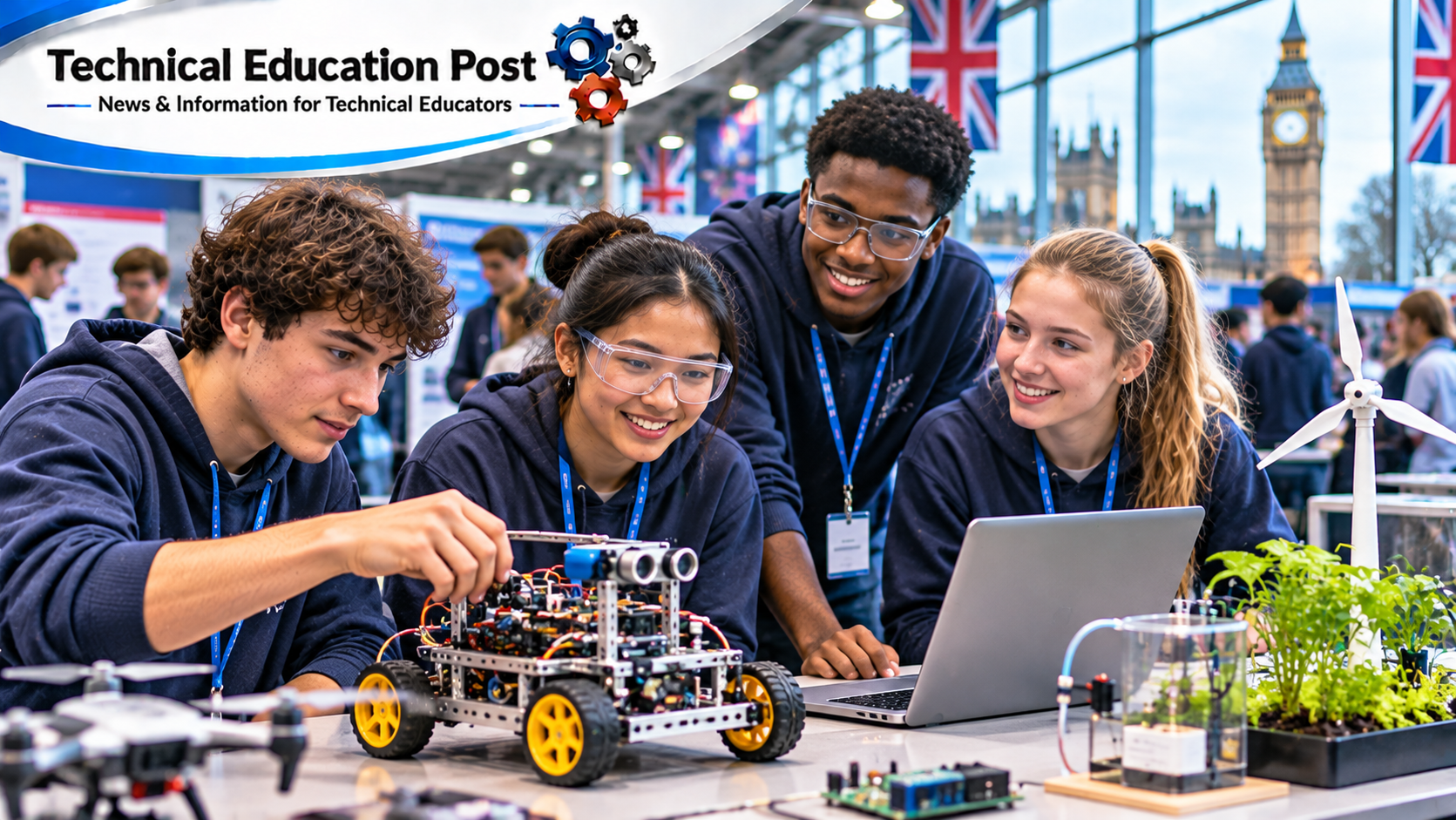

The National STEM Festival is taking its student innovation competition international for the first time, inviting young people across the United Kingdom to develop and showcase solutions to real-world challenges. Applications close November 22, 2026.
The National STEM Festival is expanding beyond the United States, with its first United Kingdom edition scheduled for May 5–10, 2027, in London.
Organized by educational media company EXPLR, the competition invites eligible young people ages 13–19 from England, Scotland, Wales and Northern Ireland to submit original projects addressing challenges in engineering, technology, healthcare, infrastructure and sustainability.
Up to 40 students will be selected as National STEM Champions, receiving funded travel and accommodations to participate in the London event.
The expansion represents an important development for project-based STEM education, connecting young innovators with scientists, engineers, educators and industry professionals.
For teachers and school leaders, the festival offers an opportunity to encourage students to apply classroom knowledge through research, design, experimentation and technical problem-solving.
With applications closing November 22, 2026, educators have a limited window to help eligible students prepare their submissions.
Key Takeaways
- First international expansion: The National STEM Festival is launching its UK edition following three years of activity in the United States.
- May 5–10, 2027: The festival will take place at venues across London.
- Up to 40 student champions: Selected participants will receive funded travel and accommodations.
- Applications close November 22: Entries must be submitted by 11:59 p.m. GMT.
- Four competition themes: Building and Infrastructure; Health and Human Potential; Technology, AI and Digital Futures; and Food, Planet and Sustainability.
- Individual projects only: Students must submit their own work, supported by written explanations, a project PDF and a short video.
What Is the National STEM Festival?
The National STEM Festival is a student innovation initiative designed to help young people investigate problems and communicate potential solutions through science, technology, engineering and mathematics.
The program was launched in the United States in 2023 and is powered by EXPLR, an educational media company focused on experiential learning.
Rather than limiting participation to a single academic subject, the festival encourages students to combine different disciplines to address practical challenges.
A student might develop an environmental monitoring device, investigate a healthcare problem, design an engineering prototype or create a software application.
The emphasis is on the student’s ability to identify a meaningful problem, investigate it systematically and explain the work undertaken.
The UK edition marks the festival’s first international expansion.
When and Where Will the UK Festival Take Place?
The festival is scheduled for May 5–10, 2027, in London.
Organizers have identified several venues associated with the event, including the Houses of Parliament, the Shard and RSA House.
Public activities are also planned for May 8–9 at 26 Leake Street in Waterloo.
The open build days are intended to give visitors opportunities to experience hands-on STEM activities and engage with student innovation.
The event will bring together selected students, educators, industry representatives and scientific mentors.
Important Dates
| Milestone | Date |
|---|---|
| Applications opened | September 16, 2026 |
| Application deadline | November 22, 2026 |
| First judging phase | November 23, 2026–January 12, 2027 |
| Finalists announced | Week of January 11, 2027 |
| Second judging phase | January 14–February 8, 2027 |
| Champions announced | February 9, 2027 |
| London festival | May 5–10, 2027 |
| Public open build days | May 8–9, 2027 |
The organizer may adjust dates when necessary and will communicate material changes.
Who Can Apply?
The UK competition is open to eligible young people who ordinarily reside in the United Kingdom.
Applicants must be at least 13 years old when submitting their application and no older than 19 on November 22, 2026.
Participants must be enrolled in an eligible secondary or pre-university education or training pathway.
This includes students attending schools, sixth forms, colleges, home-education programs and qualifying apprenticeships.
Applicants already enrolled in an undergraduate university degree program are not eligible.
UK citizenship is not required, but applicants must ordinarily reside in the country.
Individual Projects Are Required
The competition accepts individual projects rather than team entries.
Students may receive appropriate guidance and support, but the submitted work must represent their own contribution.
Each applicant may submit one project.
The competition is free to enter.
Four Themes Connect STEM With Real-World Challenges
The UK edition organizes projects into four broad categories.
These themes encourage interdisciplinary learning and allow students to investigate problems that extend beyond conventional classroom boundaries.
1. Building and Infrastructure
This category focuses on designing and improving the physical systems that communities depend upon.
Potential topics include construction, transportation, architecture, engineering materials, resilient infrastructure and sustainable buildings.
Students might investigate ways to reduce construction waste, improve accessibility or develop more efficient transportation systems.
For career and technical education programs, this theme creates connections to engineering technology, construction trades, manufacturing and technical design.
2. Health and Human Potential
This category addresses health, accessibility, human performance and quality of life.
Projects might involve medical technology, assistive devices, health monitoring, rehabilitation or innovations supporting people with disabilities.
Students must consider appropriate research ethics, safety and privacy requirements.
3. Technology, AI and Digital Futures
The technology category includes artificial intelligence, robotics, cybersecurity, software, automation and emerging digital systems.
Students may develop software tools, investigate AI applications or design systems that solve practical problems.
Projects do not need to involve advanced programming to qualify.
The central requirement is that the project addresses a relevant challenge through a thoughtful technical approach.
4. Food, Planet and Sustainability
This category focuses on environmental challenges and resource management.
Potential projects include renewable energy, water conservation, agriculture, food systems, pollution reduction, biodiversity and sustainable materials.
Students may combine scientific research with engineering design to explore practical solutions.
Why Project-Based STEM Learning Matters
Traditional STEM instruction often introduces students to established scientific concepts, mathematical methods and technical procedures.
Project-based learning gives students opportunities to apply those concepts to unfamiliar problems.
Instead of completing an exercise with a predetermined answer, students must make decisions about how to investigate a question.
They may need to design experiments, build prototypes, analyze results, identify failures and revise their methods.
These activities can develop important transferable competencies.
Technical Problem-Solving
Students learn to define a problem, evaluate possible approaches and test solutions.
Research and Evidence
Projects require participants to explain the information, observations or measurements supporting their conclusions.
Communication
Students must present their work clearly to audiences who may not share their technical background.
Collaboration and Mentorship
Although festival entries are individual, students may benefit from appropriate guidance from educators, mentors and subject matter experts.
Persistence and Iteration
Real technical problems rarely produce perfect solutions on the first attempt.
Students learn to revise designs and respond to unexpected results.
These competencies are relevant across STEM education, career and technical education, and future employment.
What Students Must Submit
The festival’s application process requires several components.
Applicants must provide project information, written responses, a project PDF and a short video.
Written Project Explanation
Students must explain the problem or question they are investigating, why it matters and what they have done.
They should describe their research process, technical approach and results.
Project PDF
The project PDF must be no longer than three pages and must not exceed 5 MB.
The first judging phase uses a blind-review process.
Students must therefore avoid including identifying information such as their name, school, teacher or photograph in materials reviewed during that phase.
Project Video
Applicants must also prepare a video of no more than two minutes.
The video should explain the project, the problem being addressed and what the student created or investigated.
Organizers emphasize that professional video production is unnecessary.
A clear recording made using a phone or computer can be sufficient.
Students should consult the official application guide for the current technical requirements.
Privacy and Research Ethics
Applicants should avoid disclosing sensitive personal information about research participants or other individuals.
Projects involving human participants, health information or potentially hazardous activities may require additional precautions.
Teachers should help students identify these concerns before submission.
How the Judging Process Works
The competition uses a two-phase evaluation process.
During the first phase, judges review written project information and the project PDF without seeing identifying applicant information.
This blind-review process is intended to focus attention on the quality of the work.
Finalists then proceed to a second phase in which authorized judges may review additional application materials, including the submitted project video.
Up to 40 National STEM Champions may be selected.
The organizer’s rules establish evaluation criteria and eligibility requirements that applicants should review before submitting.
Selected Champions Receive Funded Travel
Travel costs can create significant barriers for students participating in national and international STEM events.
The UK festival addresses this concern by providing selected champions with funded travel and hotel accommodations.
The official rules describe a champion package with an approximate maximum value of £2,000, although actual arrangements and values may vary.
Participants under 18 must attend with a parent or legal guardian.
The package includes specified travel and accommodation support for one accompanying parent or legal guardian.
This approach may help students from different regions and economic circumstances participate.
However, funding travel for selected champions does not eliminate every potential barrier to entering the competition.
Students still need access to time, materials, guidance and opportunities to develop projects.
Why International Expansion Matters for STEM Education
The National STEM Festival’s expansion into the UK reflects growing interest in connecting student innovation with broader scientific and technical communities.
Many challenges addressed through STEM education are international in scope.
Climate change, healthcare access, infrastructure resilience, cybersecurity and technological development affect communities across national boundaries.
Events that bring together students and experts from different backgrounds can expose participants to new perspectives and approaches.
For educators, international competitions also provide opportunities to compare instructional practices and explore new models of student engagement.
The Workforce Development Connection
Employers increasingly value workers who can combine technical knowledge with communication, adaptability and problem-solving.
Student innovation projects provide opportunities to practice these competencies.
A student developing a robotics prototype, for example, may encounter mechanical design, electronics, programming, testing and project documentation.
These experiences can help students understand how different technical disciplines connect in professional environments.
However, competition participation should be viewed as an educational opportunity rather than a guaranteed pathway to employment.
The greatest value comes from the competencies students develop through the process.
How Teachers Can Help Students Prepare
Educators supporting potential applicants should focus on project quality and student ownership.
Start With a Meaningful Problem
Encourage students to identify a challenge they genuinely want to investigate.
A focused problem is often more manageable than an ambitious project with unclear objectives.
Establish a Research Question
Students should be able to explain what they are trying to learn, test or improve.
Document the Process
Encourage students to maintain records of experiments, prototypes, observations and revisions.
Evaluate Evidence
Students should distinguish between demonstrated results and assumptions.
Practice Communication
Help students explain their projects to audiences unfamiliar with the subject.
Review Submission Requirements
Teachers should verify eligibility, document limits, video requirements and deadlines before students apply.
Importantly, educators should provide guidance without taking ownership of the student’s work.
Opportunities for Career and Technical Education Programs
The festival’s four themes create opportunities for participation from students pursuing applied technical pathways.
Construction students might investigate sustainable building materials.
Manufacturing students could design a more efficient production fixture.
Information technology students might develop a cybersecurity awareness tool.
Agricultural education students could investigate irrigation efficiency or crop monitoring.
These examples demonstrate that student innovation is not limited to traditional academic science courses.
Career and technical education programs frequently provide practical environments where students can investigate real problems using specialized equipment and technical skills.
For educators, the challenge is helping students translate that experience into a clear research or design project.
What Comes Next for the National STEM Festival?
The UK event is part of a broader international expansion strategy.
The organizer’s website also identifies future festival plans involving Germany and other locations.
However, those plans should be distinguished from the confirmed 2027 London event.
For the UK edition, the immediate milestone is the November 22 application deadline.
Finalists are expected to be announced in January, with champions selected in February.
The London festival will follow in May.
Educators should monitor official organizer announcements for changes to dates, venues or participation requirements.
Frequently Asked Questions
What is the National STEM Festival?
It is a student innovation initiative powered by EXPLR that provides opportunities for young people to develop and present STEM projects addressing real-world challenges.
When is the UK festival?
The event is scheduled for May 5–10, 2027, in London.
Who can apply?
Eligible students ages 13–19 who ordinarily reside in the UK and participate in qualifying secondary or pre-university education or training pathways.
What is the application deadline?
November 22, 2026, at 11:59 p.m. GMT.
How much does it cost to apply?
There is no application fee.
Can student teams enter?
No. The UK competition requires individual project submissions.
How many students will be selected?
Up to 40 National STEM Champions may be selected.
Are travel expenses covered?
Selected champions receive specified funded travel and hotel accommodations. Additional provisions apply to participants under 18 who must attend with a parent or legal guardian.
What kinds of projects qualify?
Projects may address building and infrastructure, health and human potential, technology and AI, or food, planet and sustainability.
Where can students apply?
Applications are available through the official National STEM Festival website.
TechEd Magazine Perspective
The National STEM Festival’s international expansion illustrates an important direction in STEM education: moving beyond classroom demonstrations toward authentic student-led investigation and innovation.
The strongest educational value of these competitions does not depend solely on awards or public recognition.
It comes from the process of identifying a problem, developing a technical approach, evaluating evidence and communicating results.
For schools, the opportunity is to integrate these experiences into project-based learning while ensuring that participation remains accessible to students with different backgrounds and resources.
For career and technical education programs, the festival demonstrates that applied technical skills can contribute directly to meaningful innovation.
As the program expands internationally, educators should pay particular attention to student access, mentorship quality and the lasting educational outcomes of participation.
The central lesson is that young people do not need to wait until university or employment to begin contributing to scientific and engineering problem-solving.
With appropriate guidance and opportunities, they can begin developing those capabilities now.
Sources and Further Reading
Official festival resources
National STEM Festival — UK 2027 Applications
National STEM Festival — Official UK Rules and Eligibility
National STEM Festival — Application Guide
National STEM Festival — London Event Information
Additional education-sector source
STEM Community UK — National STEM Festival: A Chance for Young People to Showcase Their Ideas
Related TechEd Magazine reading
For additional background, explore TechEd Magazine’s existing coverage of STEM curriculum development, student assessment and engineering education.