

China is accelerating efforts to integrate artificial intelligence into primary and secondary education, pursuing a national objective of widespread AI literacy among schoolchildren by 2030.
An extensive Reuters investigation published November 16, 2026, describes how schools across China are introducing AI instruction, robotics, programming activities, and AI-assisted learning systems.
The initiative is taking place within an education system serving nearly 200 million primary and secondary students.
According to the investigation, nearly half of China’s provincial-level governments have introduced binding plans addressing AI education.
Implementation varies considerably.
Some schools emphasize student programming, robotics, and digital innovation, while others use artificial intelligence to supplement teaching in communities facing shortages of qualified instructors.
The developments have implications beyond China.
As artificial intelligence becomes increasingly important in manufacturing, engineering, software development, healthcare, and other technical fields, education systems face growing pressure to prepare students for work involving automated and intelligent technologies.
For U.S. STEM and career and technical education leaders, China’s experience offers an opportunity to examine what large-scale AI education might accomplish—and what risks emerge when technological adoption moves faster than evidence of educational effectiveness.
Key Takeaways
- China is pursuing widespread AI literacy among schoolchildren by 2030.
- Nearly half of its provincial-level governments have established binding AI education plans, according to Reuters.
- Shanghai requires at least 30 hours of annual AI instruction per grade.
- Schools are adopting different approaches, including programming, robotics, tutoring, and AI-assisted classroom instruction.
- Researchers continue to raise concerns about student dependence on AI and possible effects on independent thinking.
What the Investigation Revealed
Reuters examined China’s AI education initiative through school visits, interviews, academic research, and government procurement records.
The reporting describes students working with AI-assisted software development, humanoid robots, and other emerging technologies.
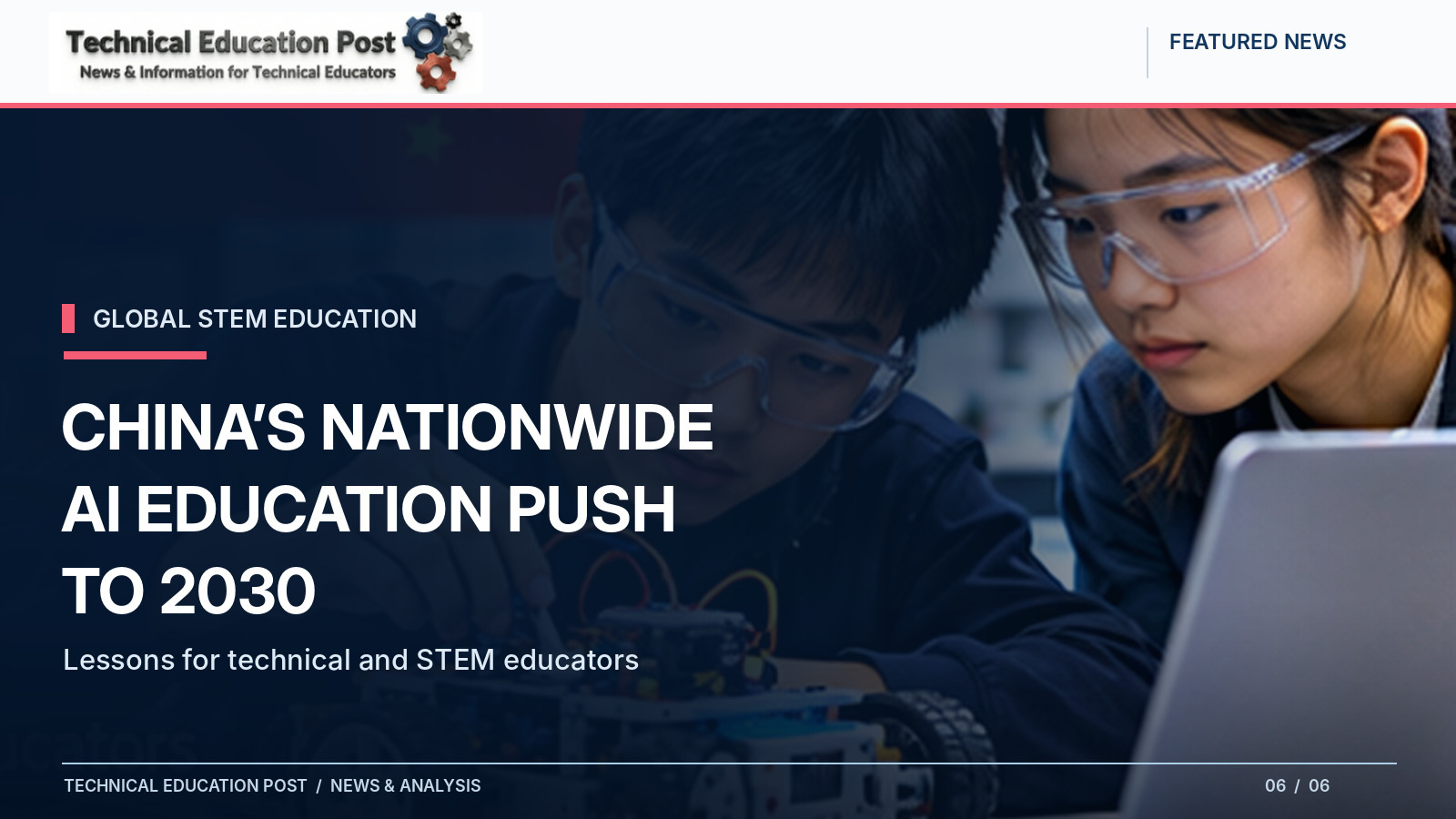
At Beijing New Talent Academy, students participate in programming and robotics activities designed to encourage experimentation and technological problem-solving.
Elsewhere, schools are using AI-generated instructional materials and digital learning systems to address educational resource challenges.
The investigation also found substantial differences in how schools implement these technologies.
Some emphasize active experimentation and creative development, while others focus on delivering instructional content through AI-assisted platforms.
These differences make it difficult to evaluate the initiative as a single educational model.
AI Literacy Is Becoming an Education Policy Priority
China’s strategy reflects a belief that artificial intelligence will play an increasingly important role in economic competitiveness and technological innovation.
Early exposure is intended to help develop future technical capabilities while making AI more familiar to students across academic disciplines.
However, there is an important distinction between access to AI systems and genuine AI literacy.
Students may become comfortable using automated tools without understanding how those tools operate, why their outputs may be unreliable, or when independent verification is necessary.
Effective literacy requires more than familiarity.
It involves understanding the capabilities, limitations, and consequences of using technology.
This distinction is also reflected in the OECD and European Commission’s 2026 AI Literacy Framework for primary and secondary education.
That framework emphasizes the knowledge, skills, and attitudes students need to understand AI, evaluate its outputs, and use it responsibly.
The Risk of AI Dependence
One of the most important findings from the Reuters investigation concerns uncertainty about how extensive AI use affects learning.
Research reviewed by the news organization produced mixed findings.
Some studies reported improvements in particular educational tasks, while others identified associations between frequent AI use and weaker performance in areas requiring independent reasoning.
Those relationships do not establish that AI causes reduced cognitive performance.
However, they reinforce the need for schools to distinguish between improving task completion and improving student understanding.
A learner who produces a correct answer with AI assistance may not necessarily be capable of explaining the reasoning behind it.
That distinction matters greatly in technical education.
An engineering student who uses AI to generate code, for example, should still be able to explain what the code does, identify errors, and determine whether it meets the requirements of the application.
The same principle applies to students using AI-assisted design software, automated diagnostics, or data-analysis tools.
What U.S. Educators Can Learn
The United States approaches educational standards and technology adoption through a decentralized system involving states, school districts, institutions, and other stakeholders.
China’s nationally coordinated approach cannot simply be transferred into that structure.
However, several educational questions are relevant across both systems.
First, schools need clear learning objectives.
Before introducing an AI application, educators should identify the specific competencies students are expected to develop.
Second, teachers need professional development.
Instructional quality depends on whether educators understand the tools they are using and can evaluate their educational value.
Third, students need opportunities to demonstrate independent understanding.
AI-supported assignments can be paired with explanations, practical demonstrations, oral assessments, and tasks completed without automated assistance.
Finally, schools need appropriate safeguards for student information and the data collected by educational technologies.
These considerations become particularly important when AI systems monitor behavior or process sensitive educational records.
Implications for Career and Technical Education
The relationship between AI education and workforce preparation is especially important in technical disciplines.
Many industries are incorporating AI into equipment monitoring, industrial automation, quality inspection, design software, and operational decision-making.
Students entering those occupations will benefit from understanding both conventional technical fundamentals and emerging intelligent systems.
A manufacturing student should understand the physical operation of a machine before relying on automated diagnostics.
A cybersecurity student should understand underlying security principles before depending on an AI-generated assessment.
A software development student should be able to evaluate and debug generated code.
In each case, artificial intelligence can become an additional capability rather than a replacement for foundational knowledge.
Frequently Asked Questions
What is China’s AI education goal for 2030?
China is working toward widespread AI literacy among schoolchildren by 2030, supported by regional education plans and classroom initiatives.
Are all Chinese schools teaching AI in the same way?
No. Implementation varies across regions and schools, with different approaches to programming, robotics, tutoring, and instructional technology.
Does greater AI use automatically improve student achievement?
No. Available research suggests potential benefits alongside unresolved questions about learning quality, dependence, and independent reasoning.
What should American STEM programs prioritize?
Programs should emphasize foundational technical knowledge, responsible AI use, critical evaluation, and the ability to demonstrate skills without relying entirely on automated assistance.
TechEd Magazine Perspective
China’s AI education initiative illustrates how quickly artificial intelligence is becoming a matter of national workforce strategy.
The scale of the undertaking is significant, but scale alone does not establish educational success.
A system can provide millions of students with access to advanced technology without necessarily demonstrating that those students are developing stronger reasoning, technical competency, or creativity.
For U.S. educators, the most useful lesson is to distinguish between technology adoption and measurable learning.
Artificial intelligence will likely become increasingly important across many technical careers.
Preparing students for that future requires more than teaching them how to generate answers.
It requires ensuring they understand the problems they are solving, can evaluate the results they receive, and possess the foundational knowledge needed to make sound decisions.
Those abilities may prove more durable than familiarity with any individual AI platform.