
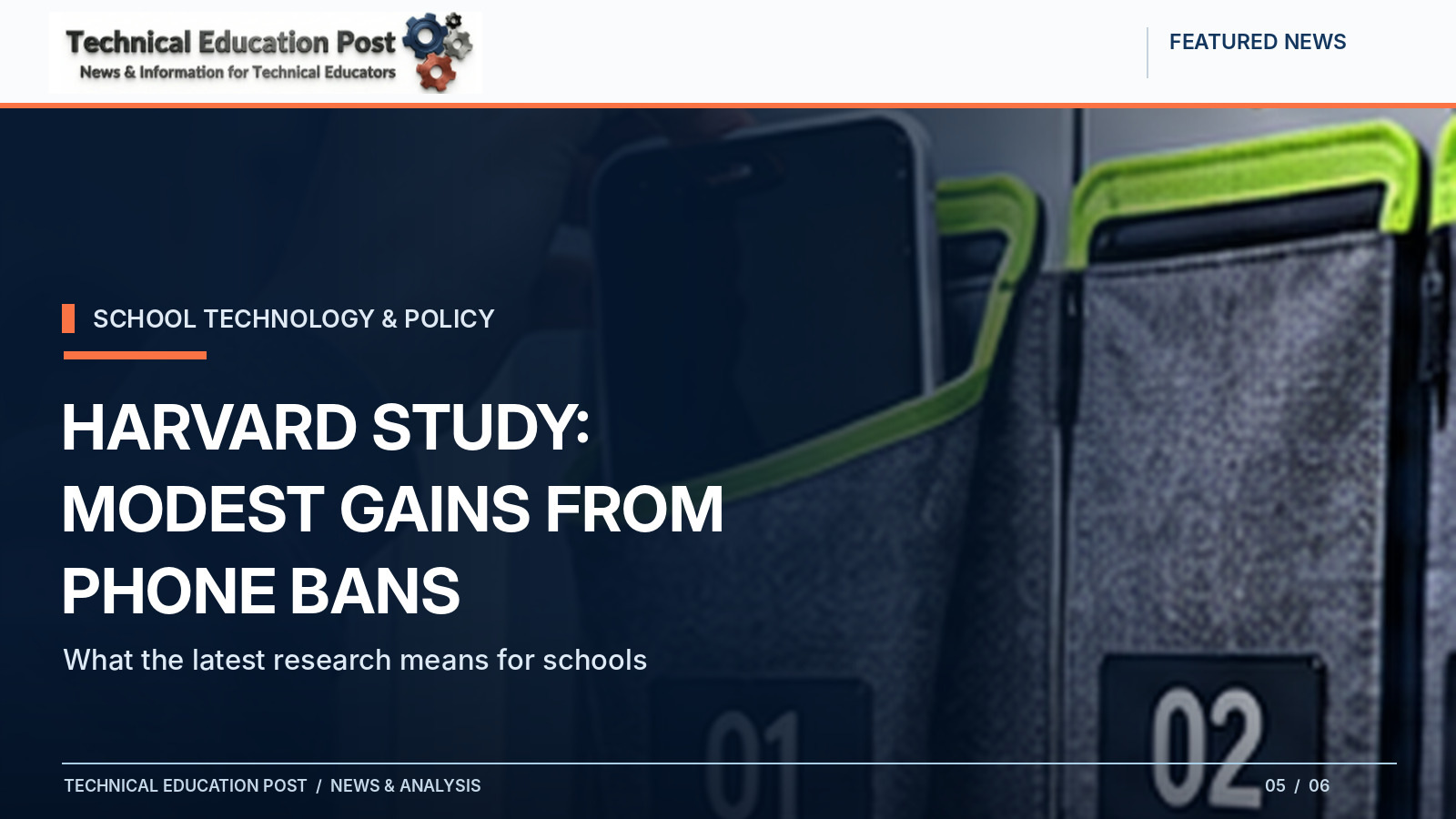

A new national study suggests that strict school cellphone bans may produce modest improvements in student academic achievement, adding fresh evidence to a debate affecting school districts across the United States.
Released November 17, 2026, the research was conducted by a team led by Harvard University’s Center for Education Policy Research, working with researchers at Dartmouth College and NWEA.
The study examined standardized testing data involving approximately 3.3 million students across 4,600 schools.
Researchers found that schools implementing strict cellphone restrictions using locked storage pouches experienced small improvements in academic growth compared with similar schools without those restrictions.
The estimated benefit was equivalent to approximately one to two additional weeks of learning over a school year.
However, the findings come with important qualifications.
Other recent research has reported little overall improvement in academic performance following cellphone bans, and researchers continue to disagree about the likely long-term benefits.
For educators and administrators, the developing evidence suggests that limiting student phone use may be useful, but it should not be treated as a replacement for effective instruction, academic support, or broader technology policies.
Key Takeaways
- A Harvard-led study released November 17 examined data involving 3.3 million students.
- Researchers estimated modest academic benefits from strict, all-day cellphone restrictions.
- The estimated gains were equivalent to approximately one or two additional weeks of learning annually.
- Earlier national research found little overall improvement in test scores.
- Schools should evaluate academic outcomes, enforcement practices, student well-being, and the role of other digital devices.
What the New Research Found
The research examined achievement growth in reading and mathematics before and after schools introduced strict cellphone restrictions.
The researchers used NWEA MAP Growth assessment data collected during the 2021–22 through 2025–26 school years.
The broader dataset included approximately 3.3 million students across 4,600 schools, with the analysis of locked-pouch restrictions focusing on schools that adopted that approach.
The reported improvements were relatively small when measured against conventional educational effect sizes.
However, researchers argue that incremental gains could become meaningful if they persist across multiple school years.
That possibility is particularly relevant because student achievement in the United States had been declining in important areas before the COVID-19 pandemic.
The researchers suggest cellphone use may have contributed to those long-term trends, although the new findings do not establish that smartphones were the sole or primary cause of the decline.
Why Other Researchers Remain Cautious
The Harvard-led findings are not the only available evidence.
An earlier national study, published as a National Bureau of Economic Research working paper in 2026, examined the effects of school restrictions using locked phone pouches.
That investigation found substantial reductions in student phone use but little overall evidence of meaningful academic improvement.
It also identified short-term increases in disciplinary incidents following implementation, although those effects diminished over time.
The two research efforts used different data and analytical approaches.
The November Harvard-led report was newly released and had not yet completed peer review, according to NPR’s coverage of the findings.
Researchers involved in the earlier study have cautioned that the newer estimates are small and that longer-term evidence is still needed.
Taken together, the studies suggest that restricting phones can change student behavior more reliably than it can currently be shown to improve academic achievement.
Why This Matters for Schools
Cellphone restrictions often begin with a straightforward educational objective: reducing distractions during instruction.
However, effective implementation involves more than introducing a rule.
Schools must consider how devices are stored, how restrictions are enforced, how families communicate during emergencies, and how educators respond when students do not comply.
Districts should also consider whether students simply shift distracting activities from smartphones to laptops or other connected devices.
Policies targeting one technology may have limited effectiveness when other devices provide access to similar distractions.
This creates a broader challenge for school technology leadership.
The objective should be to establish learning environments where digital tools support instructional goals without routinely interrupting attention.
Implications for Career and Technical Education
Technical education introduces additional considerations.
Many CTE programs rely on digital devices for equipment documentation, programming, safety information, diagnostic applications, and workplace simulations.
A student working with a programmable logic controller, for example, may need access to a computer or technical documentation as part of a legitimate learning activity.
Similarly, automotive students may use connected diagnostic equipment, while healthcare learners may interact with electronic training systems.
These instructional technologies are fundamentally different from unrestricted personal social-media use.
For CTE administrators, effective policies should distinguish between the purposeful use of digital equipment and activities unrelated to instruction.
The goal is not to remove technology from technical learning environments.
It is to establish clear expectations about when technology contributes to learning and when it interferes with it.
What Administrators Should Measure
Schools introducing or reviewing cellphone restrictions should establish appropriate measures before evaluating whether the policy has succeeded.
Useful indicators may include classroom interruptions, disciplinary incidents, student attendance, teacher observations, and changes in academic performance.
Student and family feedback can also identify unintended consequences.
Importantly, schools should avoid attributing every change in achievement to phone restrictions when other instructional or organizational changes are occurring simultaneously.
A careful evaluation should examine results over multiple terms rather than relying exclusively on immediate impressions.
Frequently Asked Questions
Do school cellphone bans improve test scores?
The evidence remains mixed. The November 2026 Harvard-led study reports modest improvements, while earlier research found little overall academic benefit.
How large were the reported gains?
Researchers estimated an effect equivalent to approximately one to two additional weeks of learning over a school year.
Does the research prove smartphones caused declining academic achievement?
No. The findings contribute evidence to the debate but do not establish a complete causal explanation for long-term achievement trends.
Should schools eliminate all classroom technology?
The research does not support that conclusion. Schools should distinguish between unnecessary distractions and technology used for educational purposes.
TechEd Magazine Perspective
The central lesson from the developing research is that technology restrictions should be evaluated according to educational results rather than assumptions.
Reducing distractions may help students concentrate, but improved concentration does not automatically produce large academic gains.
Schools still need effective teaching, appropriate curriculum, student support, and meaningful learning activities.
For technical educators, this distinction is especially important.
Students must develop the ability to use sophisticated technologies responsibly in environments where digital systems are essential to workplace performance.
The most effective school technology policies may therefore be those that teach disciplined, purposeful technology use rather than treating every device as inherently beneficial or harmful.